
Daraxonrasib in Metastatic Pancreatic Cancer: What the First RAS-Targeted Approval Means for GI Oncology
FDA approval of daraxonrasib introduces a RAS-targeted option for previously treated metastatic pancreatic adenocarcinoma.


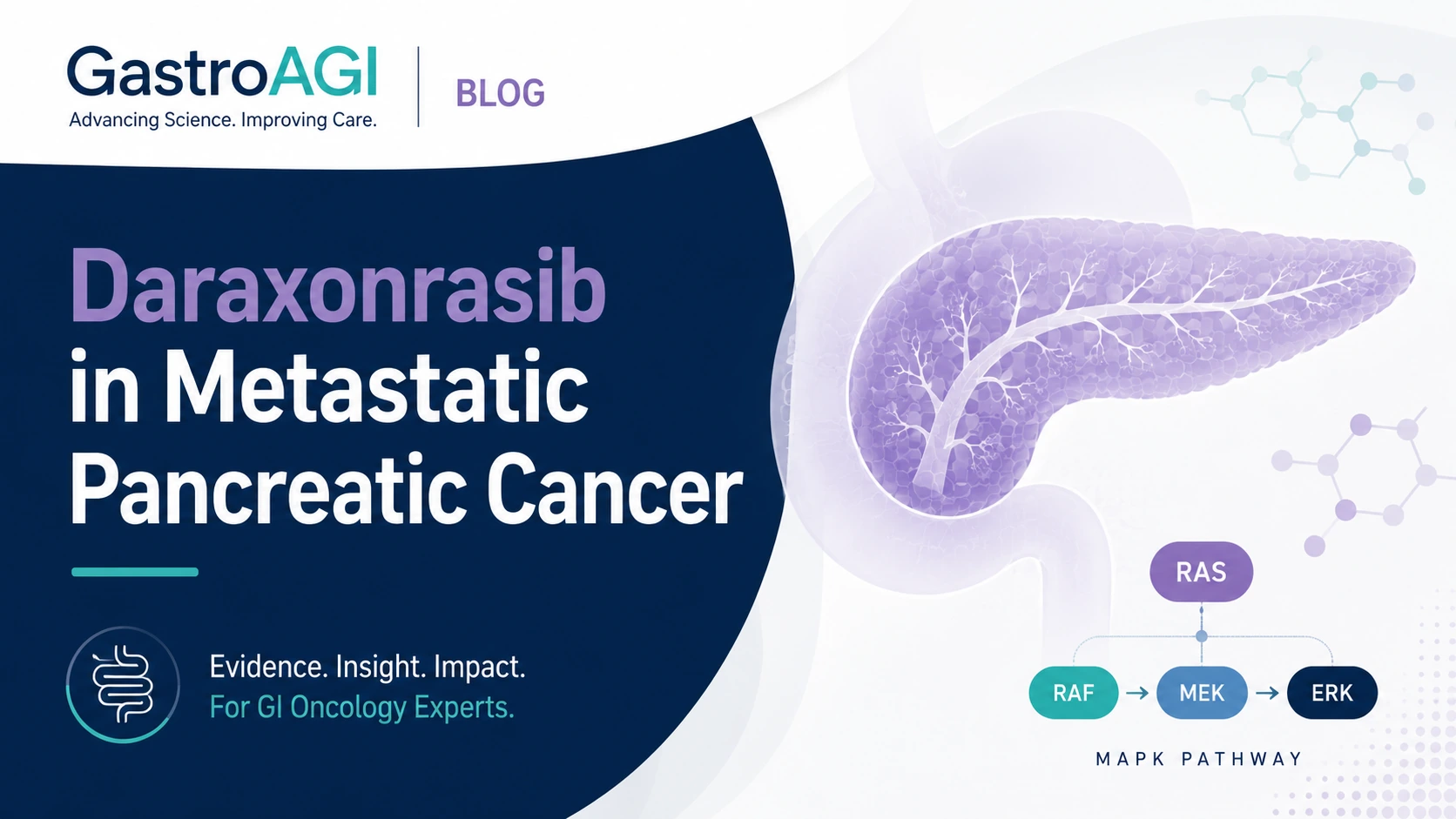
For decades, pancreatic ductal adenocarcinoma has carried one of the most frustrating contradictions in oncology: a dominant molecular driver is present in most tumors, yet direct therapeutic targeting has remained difficult. The FDA approval of daraxonrasib, marketed as Rasonque, marks an important regulatory and clinical moment because it introduces a treatment designed to inhibit RAS signaling in metastatic pancreatic adenocarcinoma.
On August 26, 2026, the U.S. Food and Drug Administration approved daraxonrasib for adults with metastatic pancreatic adenocarcinoma who have received at least one prior systemic therapy or who are not candidates for multiagent systemic therapy. GI & Hepatology News reported the same day that this is the first approved therapy that directly targets RAS in the most common form of pancreatic cancer.
The approval was based on RASolute 302, a global, randomized, open-label, multicenter phase 3 trial. The trial enrolled 500 adults with previously treated metastatic pancreatic ductal adenocarcinoma, assigning 248 patients to daraxonrasib once daily and 252 patients to investigator’s choice chemotherapy. The trial results were published in The New England Journal of Medicine under the article title “Daraxonrasib or Chemotherapy in Previously Treated Metastatic Pancreatic Cancer.”
A historically difficult target becomes clinically actionable
RAS biology has long been central to pancreatic cancer. Daraxonrasib is described as an oral, once-daily RAS(ON) multi-selective inhibitor. Unlike mutation-specific KRAS inhibitors already approved in colorectal and lung cancer, daraxonrasib suppresses signaling from mutant and wild-type RAS in the active, GTP-bound state. GI & Hepatology News notes that activating RAS mutations are present in more than 90% of pancreatic ductal adenocarcinomas.
This distinction matters clinically. Pancreatic adenocarcinoma is not a single-mutation disease for which one narrow inhibitor can address all patients. A RAS-directed strategy that is not limited to one rare variant has broader conceptual relevance in pancreatic cancer. However, clinicians should avoid interpreting this approval as a solution for all RAS-driven biology. The pivotal evidence comes from a defined metastatic population, largely consisting of patients with RAS G12 mutations, and the subgroup conclusions outside common variants require caution.
The FDA placed the approval in the context of a high-burden cancer. Pancreatic adenocarcinoma represents approximately 90%–95% of the roughly 67,000 pancreatic cancers diagnosed annually in the United States, and contributes disproportionately to cancer mortality because of late detection, aggressive disease behavior, and limited treatment options.
What RASolute 302 tested
RASolute 302 was designed to compare daraxonrasib with standard chemotherapy in patients with previously treated metastatic pancreatic ductal adenocarcinoma. Eligible patients had metastatic disease that had progressed after previous chemotherapy or shortly after neoadjuvant or adjuvant therapy, measurable disease, and good performance status.
The comparator arm allowed investigator’s choice among four cytotoxic chemotherapy regimens: gemcitabine plus nab-paclitaxel, modified FOLFIRINOX, FOLFOX, or liposomal irinotecan plus fluorouracil and leucovorin. This comparator structure reflects the real-world variability of later-line pancreatic cancer treatment, where prior exposure, tolerance, performance status, neuropathy, marrow reserve, and local practice often influence regimen selection.
The trial had two primary endpoints: overall survival and blinded independent central review–assessed progression-free survival in patients with RAS G12 mutations. The broader intention-to-treat population was also reported.
The trial was open-label, which is important when interpreting safety reporting, treatment discontinuation, and patient-reported outcomes. Overall survival is less vulnerable to open-label bias than subjective endpoints, but adverse event attribution, treatment decisions, and symptom reporting may still be influenced by knowledge of treatment assignment.
Survival benefit: the most clinically important finding
The approval rests primarily on a clear survival signal. In the overall trial population, median overall survival was 13.2 months with daraxonrasib compared with 6.7 months with chemotherapy. The reported hazard ratio was 0.40, with a 95% confidence interval of 0.30–0.53 and P < .0001.
Among patients with RAS G12 mutations, median overall survival was 13.2 months with daraxonrasib versus 6.6 months with chemotherapy, again with a hazard ratio of 0.40.
For clinicians, this is the central result. In metastatic pancreatic ductal adenocarcinoma after prior therapy, later-line systemic treatment options generally offer limited benefit. A median survival difference of this magnitude is clinically meaningful, particularly when accompanied by improvements in progression-free survival and objective response rate. Still, the result should be framed accurately: this was demonstrated in the RASolute 302 population, not across all stages of pancreatic cancer or all treatment settings.
Disease control and response outcomes
Progression-free survival also favored daraxonrasib. In the overall population, median progression-free survival was 7.2 months with daraxonrasib versus 3.6 months with chemotherapy. In the RAS G12 subgroup, median progression-free survival was 7.3 months versus 3.5 months.
Tumor response rates followed the same direction. In the overall study population, objective response rates were approximately 32% with daraxonrasib and 11% with chemotherapy. Among patients with RAS G12 mutations, response rates were 33% versus 12%.
These findings support antitumor activity beyond a survival-only signal. For GI oncologists and multidisciplinary tumor boards, response can matter when symptoms, biliary or gastric outlet compromise, pain, nutritional decline, or local tumor burden influence quality of life and care planning. However, the available source does not support claims that response translates into surgical conversion, cure, or long-term remission in this metastatic setting.
Patient-reported outcomes: relevant but not definitive alone
Patient-reported outcomes also favored daraxonrasib. Among patients with RAS G12 mutations, time to worsening of pain was reported as 9 months with daraxonrasib versus 3.7 months with chemotherapy. Time to deterioration in overall health and quality of life was 5.6 months versus 2.4 months. Similar patterns were reported in the overall study population.
This is clinically relevant because pancreatic cancer care is not only about extending survival. Pain, appetite, fatigue, functional decline, and treatment burden are central to patient experience. An oral therapy associated with delayed deterioration in patient-reported outcomes may be meaningful in a disease where palliation and survival often overlap.
That said, patient-reported outcomes in an open-label trial require careful interpretation. Patients and clinicians knew which treatment was being given. That does not negate the findings, but it means the patient-reported data should be viewed as supportive rather than as standalone proof of symptomatic superiority.
Safety profile: different toxicity, not absence of toxicity
Daraxonrasib was not toxicity-free. Grade 3 or higher adverse events occurred in 62% of patients receiving daraxonrasib and 70% receiving chemotherapy. Treatment-related grade 3 or higher events occurred in 44% versus 58%, respectively.
The toxicity pattern differed between arms. The most common treatment-related adverse events of any grade with daraxonrasib were rash, diarrhea, and stomatitis. GI & Hepatology News reported grade 3 or higher rash in 14% and stomatitis in 12% with daraxonrasib. In the chemotherapy arm, higher-grade hematologic toxicities included neutropenia, anemia, and thrombocytopenia.
Treatment-related adverse events led to discontinuation in 1% of patients receiving daraxonrasib compared with 11% receiving chemotherapy. One treatment-related death from pneumonitis occurred in the daraxonrasib arm.
The FDA lists the most common adverse reactions as rash, diarrhea, stomatitis, nausea, fatigue, vomiting, abdominal pain, edema, decreased appetite, and hemorrhage.
For clinicians, the safety message is balanced: daraxonrasib may be more tolerable than cytotoxic chemotherapy in some respects, but it introduces its own adverse event profile. Rash, mucosal toxicity, diarrhea, pneumonitis risk, and hemorrhage require recognition, monitoring, and management. Oral administration should not be equated with low clinical complexity.
What the FDA indication does—and does not—mean
The approved indication includes adults with metastatic pancreatic adenocarcinoma who have received at least one prior systemic therapy, and adults who are not candidates for multiagent systemic therapy. GI & Hepatology News notes that the approval is therefore not limited strictly to the second-line setting in which the pivotal trial was conducted.
This distinction will matter in practice. A drug can be approved for a broader clinical label than the exact pivotal-trial scenario, but clinicians should still understand where the evidence is strongest. The most direct phase 3 evidence is in previously treated metastatic pancreatic ductal adenocarcinoma. Use in patients not candidates for multiagent systemic therapy may be clinically reasonable within the approved label, but extrapolation beyond the trial population should be transparent.
Clinicians should also avoid presenting daraxonrasib as established first-line standard therapy based on RASolute 302. Ongoing studies are evaluating daraxonrasib earlier in the disease course, including RASolute 303 in first-line metastatic disease and RASolute 304 in the adjuvant setting after resection and perioperative chemotherapy. Those trials may clarify whether the drug has a role earlier, but those questions remain unanswered by the approval source.
Subgroups and the risk of overinterpretation
RASolute 302 enrolled patients across a range of RAS variants as well as patients with no identified RAS mutation. Ninety-two percent of patients in the research summary had RAS G12 mutations. Overall survival generally favored daraxonrasib across subgroups, including performance status, stage at diagnosis, liver metastases, previous treatment, and RAS mutation status.
The authors cautioned that subgroup findings were exploratory, especially for uncommon RAS mutations and tumors without an identified RAS mutation because patient numbers were small.
This is an important point for fellows and researchers. A subgroup forest plot can generate hypotheses, reassure consistency, or identify potential heterogeneity, but small subgroup analyses should not be treated as definitive evidence of benefit in every molecular category. The most secure interpretation is that the trial showed benefit in the overall population and in the large RAS G12 subgroup, while rarer molecular groups require additional evidence.
Strengths that make the trial clinically persuasive
Several features strengthen the clinical relevance of RASolute 302. It was a phase 3 randomized trial, included 500 patients, was conducted globally across 59 sites in six countries, and compared daraxonrasib against active chemotherapy options rather than placebo.
The survival endpoint is clinically hard and meaningful. Progression-free survival was assessed by blinded independent central review, which helps reduce assessment bias for radiographic outcomes. The trial also incorporated patient-reported outcomes, which are especially important in metastatic pancreatic cancer, where symptom burden and quality of life are central to treatment decisions.
The comparator arm reflected several accepted chemotherapy options. This improves pragmatic relevance, although it also introduces heterogeneity because chemotherapy choice was investigator-selected rather than a single uniform regimen.
Limitations that should temper implementation
The open-label design is a key limitation. While overall survival is robust, open-label treatment assignment may influence adverse event reporting, chemotherapy discontinuation, timing of assessments, and subjective patient-reported outcomes.
Another limitation is that 15% of patients assigned to chemotherapy never started treatment. This can complicate interpretation of comparative tolerability and real-world applicability, particularly if non-initiation reflects rapid clinical decline or patient preference.
Subgroup analyses outside RAS G12 mutations are limited by small numbers. The study supports daraxonrasib as a major advance in the studied population, but it does not fully define benefit by every RAS subtype, by patients without identified RAS mutation, or by biomarker-negative clinical scenarios.
Funding and analysis involvement also require transparency. GI & Hepatology News reports that Revolution Medicines funded the study, helped develop the protocol, and performed and validated statistical analyses. This does not invalidate the findings, but it reinforces the need for independent scrutiny, post-approval evidence, and real-world outcomes.
Practical interpretation for GI oncology clinics
For clinicians managing metastatic pancreatic adenocarcinoma, daraxonrasib changes the treatment discussion after prior systemic therapy. It provides an oral RAS-targeted option with demonstrated improvement in overall survival, progression-free survival, objective response, and patient-reported deterioration endpoints compared with chemotherapy in RASolute 302.
The discussion with patients should remain precise. The evidence supports improved outcomes in a trial population with previously treated metastatic pancreatic ductal adenocarcinoma. It does not establish cure, does not replace multidisciplinary supportive care, and does not answer every sequencing question. Patients still require careful symptom management, nutrition support, biliary and gastric outlet assessment when relevant, thromboembolic vigilance, germline and somatic testing where appropriate, and early palliative care integration.
For researchers, the approval opens several questions: mechanisms of resistance to sustained RAS inhibition, optimal sequencing after daraxonrasib, value in first-line combinations, activity in non-G12 or no-identified-RAS subgroups, and biomarkers beyond RAS mutation status that might predict benefit or toxicity.

Clinical Takeaway
Daraxonrasib is now FDA-approved as a RAS-targeted oral therapy for adults with metastatic pancreatic adenocarcinoma who have received at least one prior systemic therapy or who are not candidates for multiagent systemic therapy. The approval is supported by RASolute 302, a randomized, open-label, multicenter phase 3 trial in 500 adults with previously treated metastatic pancreatic ductal adenocarcinoma.
The key finding is a median overall survival of 13.2 months with daraxonrasib versus 6.7 months with chemotherapy in the overall population, with parallel improvements in progression-free survival and response rate. Toxicity was clinically significant but differed from chemotherapy, with rash, diarrhea, and stomatitis prominent and one reported treatment-related death from pneumonitis.
This is a clinically meaningful development in GI oncology, but it should be presented accurately. It is evidence from a phase 3 trial and an FDA approval—not proof of cure, not a first-line standard based on current reported data, and not definitive evidence for every rare molecular subgroup. The next phase of evidence will need to define optimal sequencing, earlier-line use, resistance patterns, and real-world safety.
Five key clinical takeaways
Daraxonrasib is FDA-approved for adults with metastatic pancreatic adenocarcinoma after at least one prior systemic therapy or when patients are not candidates for multiagent systemic therapy.
RASolute 302 was a randomized, open-label, multicenter phase 3 trial comparing oral once-daily daraxonrasib with investigator’s choice chemotherapy in 500 adults with previously treated metastatic PDAC.
Median overall survival favored daraxonrasib, 13.2 months versus 6.7 months in the overall population.
The toxicity profile differed from chemotherapy, with rash, diarrhea, and stomatitis prominent; one treatment-related pneumonitis death was reported.
The approval is clinically important but should not be overextended to imply cure, established first-line use, or definitive benefit in every rare RAS subgroup.
Source reference: O’Reilly EM, Wainberg ZA, Hendifar AE, et al.; RASolute 302 Trial Investigators. “Daraxonrasib or Chemotherapy in Previously Treated Metastatic Pancreatic Cancer.” The New England Journal of Medicine. 2026. DOI: 10.1056/NEJMoa2605555. FDA approval announced August 26, 2026.
References

We are pioneers in clinical intelligence, dedicated to helping gastroenterologists harness the power of artificial intelligence to drive precision, efficiency, and patient growth.