
GVAX Pancreatic Cancer Vaccine: What the 2026 Trial Data Means for PDAC Care
GVAX pancreatic cancer vaccine explained: mechanism, 2026 trial data with pembrolizumab and SBRT, and where this immunotherapy fits in PDAC care today.


A patient two weeks out from a Whipple for resected pancreatic adenocarcinoma sends you a news link about a "cancer vaccine" and asks if she should be getting it instead of chemotherapy. The article is accurate but incomplete, and the gap between what it says and what a GI oncology team actually does with this data is exactly where these conversations go wrong. Here's what the vaccine is, what the evidence supports, and how to answer her.
The Clinical Problem With Pancreatic Cancer Vaccine Coverage
The GVAX pancreatic cancer vaccine is not new, but it keeps resurfacing in patient-facing media every time a new trial reports out, and each cycle of coverage tends to flatten years of incremental data into a single hopeful headline. Developed at Johns Hopkins by Elizabeth Jaffee and Daniel Laheru, GVAX is a whole-cell, GM-CSF–secreting allogeneic vaccine designed to convert pancreatic ductal adenocarcinoma from an immunologically "cold" tumor into one immune cells will actually enter and attack. That mechanism is real and well-documented. What's harder to communicate is that GVAX remains investigational, is never used as monotherapy in place of chemotherapy, and its clinical benefit so far is measured mostly in immune correlates and pathologic response rather than confirmed survival gains in randomized trials. Patients need that distinction before they build expectations around it.
How GVAX Primes an Anti-Tumor Immune Response
GVAX is manufactured from irradiated allogeneic pancreatic cancer cell lines genetically modified to secrete granulocyte-macrophage colony-stimulating factor. The irradiation halts proliferation without destroying the cells' antigenic surface proteins. Injected intradermally, the GM-CSF acts as a chemoattractant, drawing dendritic cells and other antigen-presenting cells to the injection site, where they take up tumor antigens — including mesothelin, a target expressed on most PDAC cells — and traffic to regional lymph nodes to prime CD8+ T cells.
This matters clinically because PDAC is characteristically immune-excluded: dense desmoplastic stroma and an immunosuppressive microenvironment keep effector T cells from infiltrating the tumor, which is also why single-agent PD-1/PD-L1 blockade has performed poorly in this disease. The rationale for GVAX is that priming a mesothelin-specific T-cell response systemically, then pairing it with a second hit — cyclophosphamide to blunt regulatory T cells, or stereotactic body radiation to release additional antigen and remodel the stroma — creates a combination that checkpoint inhibitors alone cannot. A 2026 Nature Communications study formalized this logic in locally advanced disease, sequencing induction chemotherapy, then cyclophosphamide, pembrolizumab, GVAX, and SBRT before reassessing patients for resection.
Case in Point
A 61-year-old man presents with locally advanced pancreatic adenocarcinoma of the body, encasing the celiac axis on staging CT, with no distant metastases. He completes eight cycles of FOLFIRINOX with a partial response but remains borderline unresectable on restaging imaging. His oncology team enrolls him on a neoadjuvant protocol combining cyclophosphamide, pembrolizumab, GVAX, and SBRT prior to surgical reassessment.
Three months later, restaging shows no new lesions and reduced vascular encasement, and he proceeds to a margin-negative distal pancreatectomy. His surgical pathology shows increased CD8+ T-cell infiltration compared to historical FOLFIRINOX-and-SBRT-only specimens — the biologic signal the trial was actually designed to detect, distinct from a guarantee of long-term survival benefit. This is the honest framing to give patients: converting an unresectable tumor into a resectable one is a meaningful, discussable outcome — a confirmed survival advantage from the vaccine component is not yet established.
What the Trial Data Actually Shows
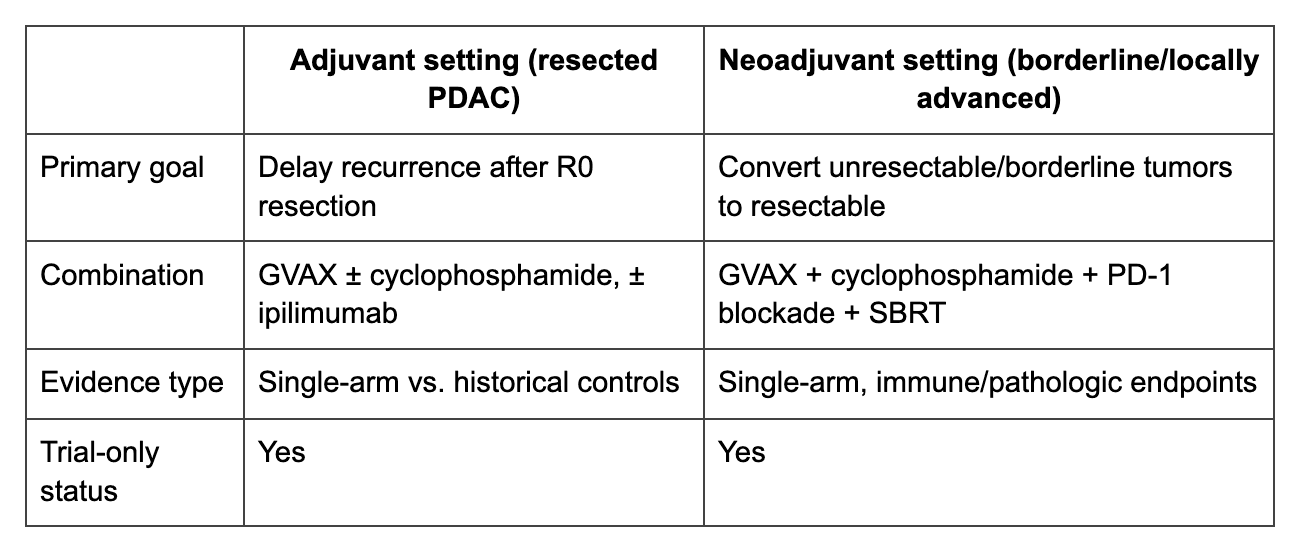
The data supporting GVAX has accumulated in stages, and none of it currently supports monotherapy or first-line use. The original Johns Hopkins phase II adjuvant trial in 60 resected, mostly node-positive patients reported a median overall survival of 24.8 to 26.8 months across reported analyses, compared with a historical range of 17 to 22 months for surgery plus adjuvant chemoradiation alone — encouraging, but a single-arm comparison against historical controls, not a randomized result. A later phase II study combining GVAX with ipilimumab as maintenance therapy in metastatic disease, published in Clinical Cancer Research, showed the addition of checkpoint blockade did not clearly improve outcomes over GVAX alone in that setting.
The more relevant recent work is neoadjuvant: the borderline-resectable GVAX-cyclophosphamide-nivolumab-SBRT trial and the 2026 locally advanced pembrolizumab-based protocol both used the vaccine to convert marginal candidates into surgical candidates while tracking immune infiltration as the primary endpoint, not survival. That distinction — pathologic and immunologic endpoints versus confirmed overall survival — is the single most important thing to communicate when a patient brings in coverage of this vaccine.
A Frequently Overlooked Point
The detail patients and even some referring clinicians miss is that GVAX's value proposition was never "better chemotherapy" — it was a strategy to overcome PDAC's specific resistance to checkpoint inhibition by manufacturing the T-cell response those drugs need to work with. Every combination trial since the original adjuvant study has been chasing that same problem: checkpoint blockade alone fails in PDAC because there's nothing for it to unleash. Framing GVAX as a vaccine that "boosts immunity" in the generic sense undersells the actual mechanism and invites patients to weigh it against chemotherapy as if they were interchangeable options, when in every published protocol it has been given alongside standard therapy, never instead of it.
Bottom Line for Clinical Practice
GVAX is available only through clinical trials at select academic centers — it has no FDA approval and should never be presented to patients as a standard-of-care alternative to chemotherapy.
Refer interested, eligible patients to ongoing trials (search NCT registries for active Johns Hopkins/Sidney Kimmel protocols) rather than describing it as generally accessible immunotherapy.
In resected disease, the survival data behind GVAX comes from single-arm trials against historical controls — communicate this as promising, not proven.
In locally advanced or borderline resectable disease, the current evidence supports GVAX-based regimens as a strategy to improve resectability and immune infiltration, not as a confirmed survival intervention.
Correcting the "vaccine versus chemotherapy" framing before a patient walks into oncology consult saves that visit from starting on the wrong premise.
Next time a patient forwards you a headline like this mid-workup, run the actual trial data and staging details through GastroAGI — it separates what's investigational from what's actionable and gives you a guideline-anchored answer before the follow-up visit.
Read Next: Sphingolipid Metabolism and KRAS in Pancreatic Cancer: A New Translational Signal


We are pioneers in clinical intelligence, dedicated to helping gastroenterologists harness the power of artificial intelligence to drive precision, efficiency, and patient growth.