
Hepatic Encephalopathy in 2026: What the New ACG Guideline Changes About How You Diagnose, Treat, and Prevent It
The 2026 ACG hepatic encephalopathy guideline: 24 GRADE-based recommendations on diagnosis, lactulose, rifaximin, TIPS, and transplant access.


Your cirrhotic patient is confused. Ammonia is elevated. You start lactulose and order a CT head out of habit. If that sequence sounds familiar, the new ACG hepatic encephalopathy guideline - published in March 2026 - is going to make you rethink several of those reflexes. Here is what changed, what stayed the same, and what it means for the patient in front of you tonight.
Hepatic encephalopathy remains one of the most clinical challenging complications of cirrhosis - not because the diagnosis is obscure, but because the spectrum from covert to overt disease is wider than most clinicians manage systematically. The 2026 ACG guideline is the first to consolidate diagnosis, inpatient management, recurrence prevention, nutrition, TIPS-related HE, and transplant access into a single GRADE-based framework. Before this guideline, most clinicians were working from fragmented guidance across AASLD, EASL, and institutional protocols. The 24 recommendations now provide a unified, evidence-ranked reference for the full clinical journey.
This is not a marginal update. Several recommendations directly contradict common practice.
Diagnosing Covert and Minimal HE: Stop Relying on Ammonia Alone
The first section of the new hepatic encephalopathy guidelines 2026 deals with covert hepatic encephalopathy (CHE) and minimal hepatic encephalopathy (MHE) - the grades most frequently missed in clinic because patients do not look overtly encephalopathic.
The guideline makes two important diagnostic moves here. First, it recommends a single-test strategy over a two-test combination when evaluating for MHE or CHE. This is a practical shift - it reduces the diagnostic burden without sacrificing sensitivity in most clinical settings. Second, and more consequentially, it explicitly recommends against using serum ammonia levels alone to make the diagnosis of MHE or CHE.
This matters because ammonia is still reflexively ordered as a screening tool in many hepatology clinics. The guideline is clear: ammonia does not reliably differentiate covert from overt disease, and its level does not correlate consistently with HE grade. Clinicians should instead rely on validated neuropsychological testing tools - the Psychometric Hepatic Encephalopathy Score (PHES), the Animal Naming Test, or the EncephalApp Stroop test - depending on local availability.
On treatment of MHE and CHE: the guideline suggests treatment with lactulose over no treatment, but acknowledges the evidence for preventing progression to overt HE remains insufficient to make a strong recommendation. In other words - treating covert HE is reasonable but not mandatory, and the decision should be individualized based on patient circumstances, driving status, occupation, and quality of life impact.
Case in Point
A 58-year-old male with Child-Pugh B cirrhosis from NASH presents for a routine follow-up. His family reports subtle personality changes over the past three months - slower responses, occasional confusion with dates, increased irritability. On examination he is oriented but takes noticeably longer to answer questions. Ammonia is 62 µmol/L - mildly elevated, but his baseline is unknown.
His hepatologist administers the Animal Naming Test bedside - he names 11 animals in 60 seconds (below the age-adjusted threshold of 14). EncephalApp Stroop is borderline. He is diagnosed with covert hepatic encephalopathy. After discussion with the patient and his family, lactulose is initiated with a target of two to three soft bowel movements daily. At follow-up eight weeks later, his family reports meaningful improvement in cognitive sharpness. His driving status is reviewed and he continues to drive for now, with a plan to reassess.
Inpatient Management: Two Recommendations That Should Change Your Workflow
For overt HE presenting in the inpatient setting, the 2026 guideline makes its strongest recommendations.
On ammonia testing during admission: The guideline recommends against routine serial serum ammonia monitoring to guide treatment decisions in overt HE. Ammonia does not track reliably with clinical response, and repeated testing adds cost without changing management. Lactulose titration should be guided by clinical response - stool frequency and mental status - not ammonia trajectory.
On brain imaging: In a cirrhotic patient with confusion and no new-onset focal neurologic deficits, the guideline recommends against routine brain imaging. This does not mean CT head is never appropriate - it means it should not be a default order. If there are focal signs, new seizure activity, head trauma, or atypical features, imaging is indicated. Otherwise, it adds radiation and cost without diagnostic yield in classic HE.
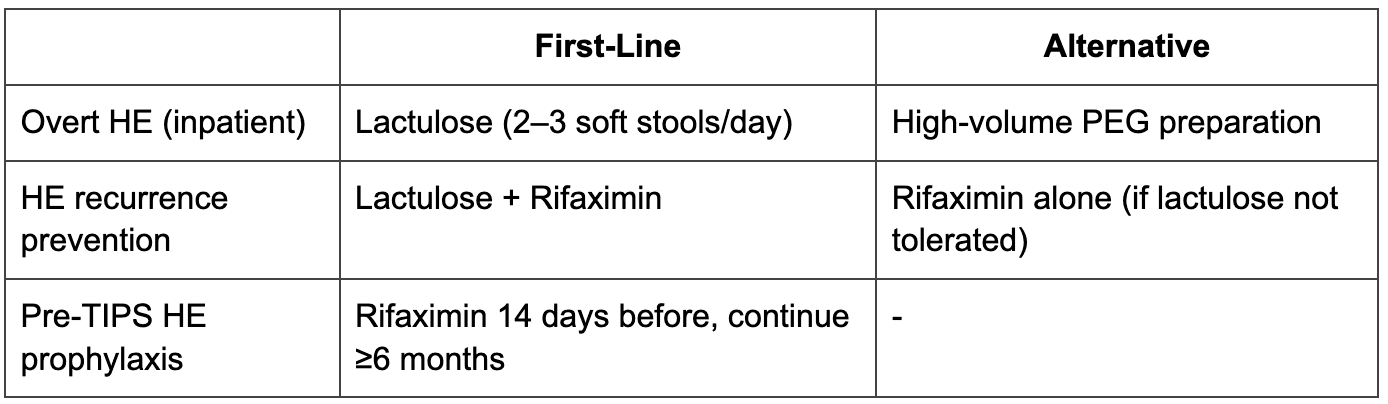
First-line treatment: Lactulose remains the recommended first-line therapy for overt HE, with a target of two to three soft bowel movements per day. The guideline introduces a notable alternative: high-volume polyethylene glycol (PEG) preparation - essentially a bowel prep - is now suggested as an option for patients who do not tolerate lactulose or where rapid gut clearance is the priority. Several trials have shown PEG to be non-inferior and in some cases faster-acting than lactulose for acute episodes.
Rifaximin for TIPS: One of the most operationally specific recommendations in the entire guideline covers TIPS procedure management. The guideline recommends initiating rifaximin 14 days before elective TIPS insertion and continuing for at least six months post-procedure in patients with decompensated cirrhosis, regardless of prior HE history. It also suggests embolizing extrahepatic portosystemic collaterals at the time of TIPS to reduce post-TIPS HE risk. Both recommendations are concrete, time-specific, and immediately actionable.
A Frequently Overlooked Point: The Transplant Access Gap for Recurrent HE
Most hepatologists are aware that MELD score drives transplant listing. What the 2026 guideline addresses explicitly - and what rarely gets documented adequately - is that recurrent HE substantially impairs quality of life and cognitive function without necessarily elevating MELD to transplant-eligible thresholds. The guideline specifically notes that the progression from covert to overt HE is not adequately reflected in current transplant listing criteria, leaving patients undertreated for transplantation despite significant burden. For patients with multiple HE episodes and MELD below 15, the guideline suggests evaluating candidacy for living donor liver transplantation. This is a clinical pathway that should be discussed earlier and documented more consistently than it currently is in most hepatology practices.
Bottom Line for Clinical Practice
Do not use serum ammonia alone to diagnose MHE or CHE - use validated psychometric tools (PHES, Animal Naming Test, EncephalApp Stroop).
Stop ordering routine brain CT in cirrhotic patients with confusion and no focal neurologic signs - it changes management only in atypical presentations.
Stop following serial ammonia levels to track inpatient HE response - titrate lactulose to stool frequency and clinical mental status instead.
PEG preparation is now a guideline-endorsed alternative to lactulose for acute overt HE - consider it when lactulose is not tolerated or rapid clearance is needed.
Start rifaximin 14 days before elective TIPS and continue for at least six months - this applies even in patients with no prior HE history.
Document HE burden explicitly in patients with MELD <15 and recurrent episodes - low MELD does not mean low disease burden, and living donor transplant candidacy should be discussed earlier.
For a practical grading reference alongside this post, see Hepatic Encephalopathy: West Haven Grading, Identifying the Precipitant, and Step-by-Step Management. If SBP is on your differential as a precipitant, Spontaneous Bacterial Peritonitis: PMN Threshold, Antibiotic Selection, and Prophylaxis Protocol covers the full workup. And for the higher-stakes admission where the underlying liver disease is unclear, ACLF vs ALF: How to Tell Them Apart and Why It Changes Everything About Treatment is worth having open in parallel.
When your next cirrhotic patient presents with confusion, or you are planning a TIPS procedure, or you are trying to decide whether to treat a patient whose family says "he just seems slower lately" - walk GastroAGI through the clinical details. It returns a guideline-anchored, case-specific response in seconds, so the 2026 ACG recommendations are applied to your actual patient, not just the textbook one.Try GastroAGI →

We are pioneers in clinical intelligence, dedicated to helping gastroenterologists harness the power of artificial intelligence to drive precision, efficiency, and patient growth.