
IBD Biologic Sequencing After Anti-TNF and Vedolizumab Failure: Choosing the Third-Line Agent
A practical framework for choosing the third biologic or small molecule after anti-TNF and vedolizumab failure in Crohn's disease and UC.


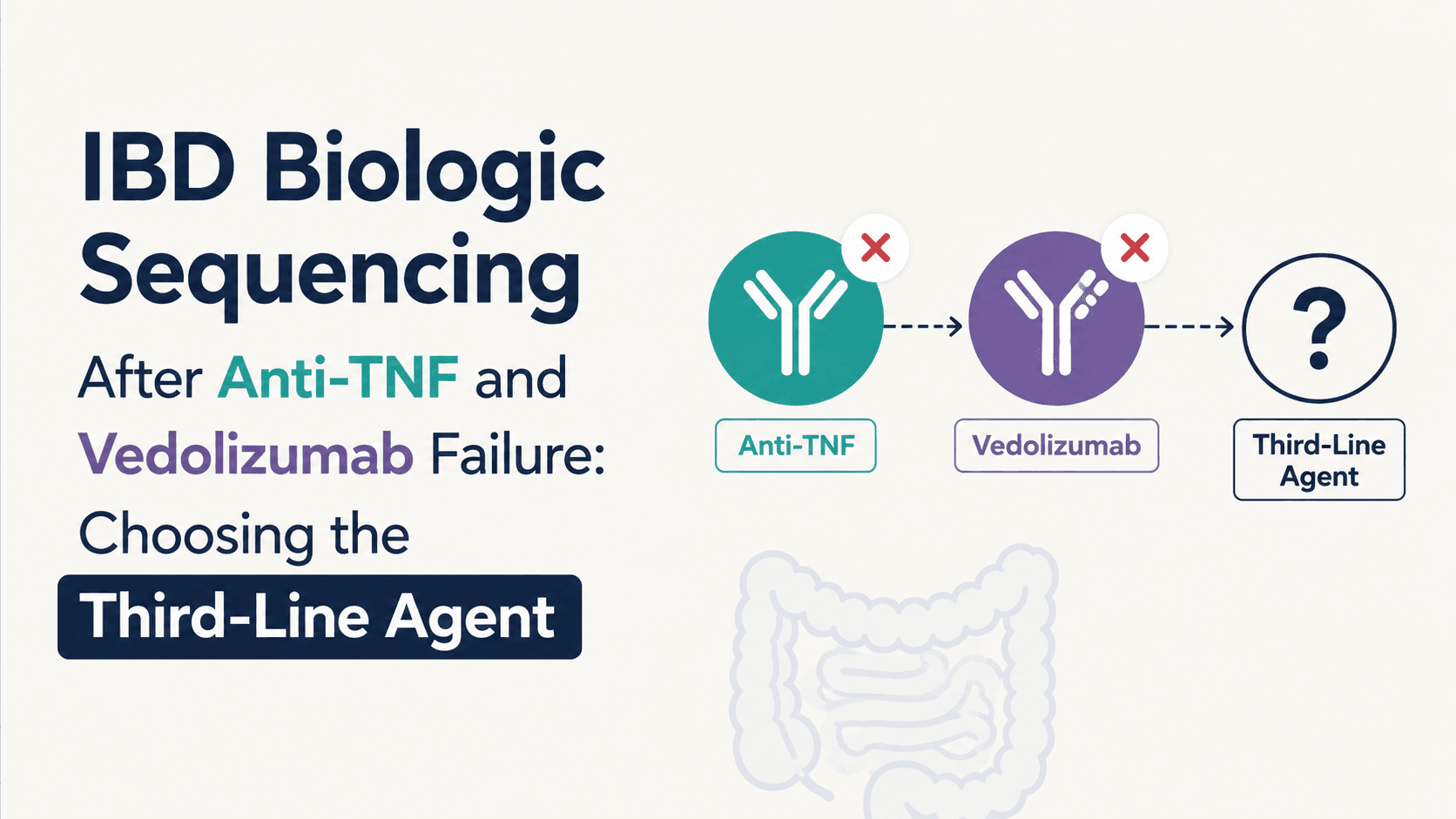
A 31-year-old woman with ileocolonic Crohn's disease has lost response to adalimumab after eighteen months, switched to vedolizumab, and now presents at week 30 with a CRP of 42, a calprotectin over 800, and a repeat colonoscopy showing unhealed ulceration. Two mechanisms are gone. The next choice is no longer obvious, and it carries more weight than either of the first two.
The core clinical problem
Sequencing after a single biologic failure is well-trodden ground — the data on anti-TNF-to-vedolizumab or anti-TNF-to-ustekinumab switches is deep, and most gastroenterologists move through it reflexively. Dual failure is different. Once anti-TNF and vedolizumab have both failed, the remaining evidence base is thinner, drawn mostly from post-hoc trial subgroups and real-world cohorts rather than trials designed around this population. IBD biologic sequencing after anti-TNF and vedolizumab failure has to account for how mechanism of failure — immunogenic loss of response versus primary non-response versus mechanistic exhaustion — changes the odds for whatever comes next, and clinicians who treat this decision the same way they treated the first switch tend to underestimate how much efficacy has already eroded.
What the data actually shows about efficacy decay
Across pivotal trials for ustekinumab, vedolizumab, and risankizumab, remission rates fall in a fairly consistent stepwise pattern as prior biologic exposure accumulates — patients with zero or one prior failure respond meaningfully better than those with two or more. The upadacitinib U-ENDURE program is the clearest illustration of this in a dual-refractory population specifically: efficacy outcomes were stratified not just by number of prior failures but by which classes had failed (anti-TNF, ustekinumab, vedolizumab/natalizumab), and patients with prior failure of two or more mechanisms still derived clinical benefit from upadacitinib, though at lower absolute rates than biologic-naive patients. That is the central, practice-changing finding for this scenario: a JAK inhibitor doesn't reset the deck, but it does not appear to lose efficacy proportionally to the number of prior mechanisms exhausted, which distinguishes it from what's typically seen when cycling between antibody classes with overlapping resistance patterns. Sequencing decisions get harder still in fistulizing phenotypes — see our post on ustekinumab for fistulising perianal Crohn's disease and what the GETAID trial adds for how mechanism choice changes when perianal disease is in the picture.
Per the ACG Clinical Guideline for Crohn's disease, the decision after dual biologic failure should also reconsider whether the original diagnosis, phenotype, and disease location were fully characterized — stricturing or penetrating disease that looks like drug failure is sometimes a surgical problem wearing a pharmacologic mask.
Case in point
A 44-year-old man with Crohn's ileitis failed infliximab due to antibody formation at month nine, then failed vedolizumab with adequate trough levels and no antibodies after seven months of therapy — a mechanistic non-response rather than an immunogenic one. Repeat imaging confirmed active inflammation without stricture.
Given confirmed mechanistic (not pharmacokinetic) failure of both an anti-TNF and an anti-integrin, the team moved to upadacitinib rather than cycling to ustekinumab, reasoning that a genuinely different pathway — JAK-STAT inhibition rather than another surface-receptor-targeted antibody — offered better odds than a third antibody-class agent given how the first two had failed. He achieved clinical response by week 8 and endoscopic improvement at week 26.
Choosing between ustekinumab, risankizumab, and JAK inhibition as the third agent
The comparison usually comes down to two questions: how much of the original response was pharmacokinetic versus mechanistic, and how much the safety profile matters for this particular patient.
Ustekinumab or risankizumab (IL-12/23 or IL-23 blockade): A reasonable next mechanism if trough levels on the prior anti-TNF or vedolizumab were adequate but response still failed — genuine mechanistic failure of the first two pathways doesn't predict failure of a third that hasn't been tried. IL-23-selective agents like risankizumab now have head-to-head data against ustekinumab in this setting and a favorable long-term safety record.
Upadacitinib or other JAK inhibitors: Worth prioritizing when the patient has failed multiple antibody-based mechanisms, when extraintestinal manifestations (peripheral arthritis, in particular) are prominent, or when oral dosing matters for adherence. The trade-off is a boxed warning profile that requires a real conversation about cardiovascular and thromboembolic risk, especially in patients over 65 or with existing risk factors.
If genuinely useful to the patient in front of you, framing it as pharmacokinetic failure → try a mechanism-appropriate re-challenge or dose optimization, versus mechanistic failure → change class entirely, keeps the decision tractable instead of defaulting to "whatever hasn't been tried yet."
A frequently overlooked point
The instinct after two failures is to treat the third agent selection as the most important decision in the case, but the more consequential error is skipping therapeutic drug monitoring before making that call. A patient labeled as a vedolizumab failure with subtherapeutic troughs and no antibodies hasn't failed the mechanism — they've failed the dose. It's also worth ruling out a genuinely different driver before cycling to a fourth mechanism: a subset of refractory patients carry anti-IL-10 neutralizing autoantibodies rather than conventional treatment-resistant IBD — a mechanistically distinct, HLA-linked subtype that downstream cytokine blockade won't touch, and one worth testing for before assuming you've simply run out of biologics.
Bottom line for clinical practice
Confirm mechanistic failure with trough levels and antibody testing before concluding a drug — rather than a dose — has failed.
After confirmed dual mechanistic failure, JAK inhibition (upadacitinib) retains meaningful efficacy and doesn't appear to decay proportionally with prior biologic count, per U-ENDURE subgroup data.
Reserve a third antibody-class agent (ustekinumab or risankizumab) for cases where the prior two failures were pharmacokinetic, immunogenic, or otherwise mechanism-specific rather than a true ceiling on antibody-based therapy.
Re-image or re-scope before assuming pharmacologic failure — stricturing disease masquerading as drug failure is a surgical referral, not a fourth biologic.
Discuss cardiovascular and thromboembolic risk explicitly before starting a JAK inhibitor in this population; the discussion belongs in the chart, not just the consent form.
Cases like this rarely resolve from a single guideline table — they need the trough levels, the imaging, and the phenotype pulled together in one place before the next agent gets chosen. Walk GastroAGI through a case like this and it will return a reasoned, guideline-anchored response in seconds.


We are pioneers in clinical intelligence, dedicated to helping gastroenterologists harness the power of artificial intelligence to drive precision, efficiency, and patient growth.