
MASH Screening in Type 2 Diabetes: What a 2026 JHEP Reports Cost-Utility Analysis Means for Liver Care Pathways
A 2026 JHEP Reports model supports staged non-invasive MASH screening in type 2 diabetes, but results remain policy-oriented.


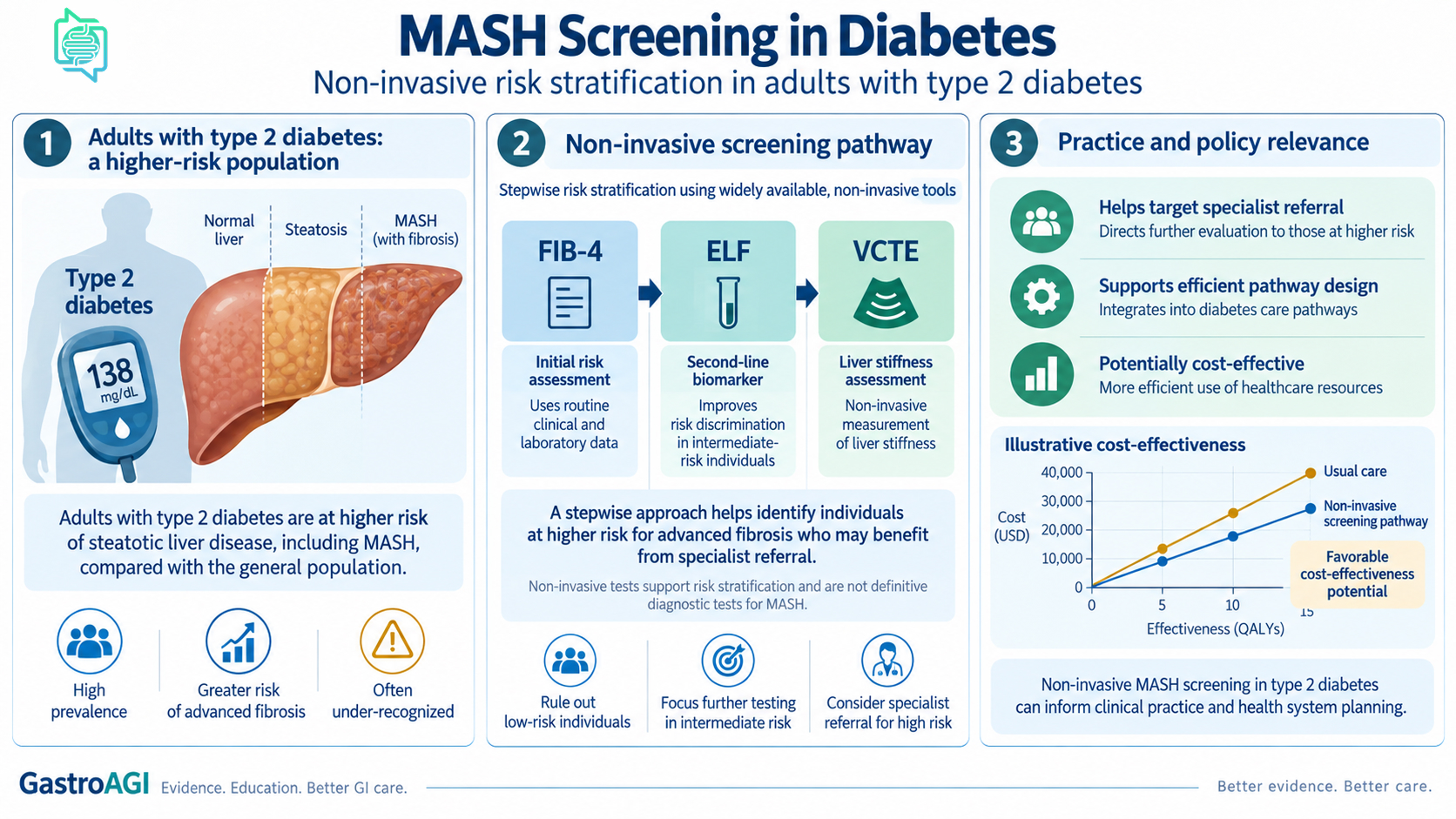
For hepatologists and gastroenterologists, one of the most difficult questions in metabolic liver disease is not whether adults with type 2 diabetes are a high-risk group. That part is increasingly accepted. The harder question is operational: how should health systems identify clinically important metabolic dysfunction-associated steatohepatitis, or MASH, before patients present with advanced fibrosis, cirrhosis, or liver-related complications?
The 2026 JHEP Reports article, “Screening for Metabolic Dysfunction-Associated Steatohepatitis in Adults with Type 2 Diabetes in the U.S. and 5 European Countries: A Cost-Utility Analysis,” directly addresses this implementation problem. Published on September 7, 2026, the study used a decision-analytic Markov model to evaluate the cost-effectiveness of screening strategies for MASLD/MASH in hypothetical cohorts of adults with type 2 diabetes across the United States and five European countries: the United Kingdom, France, Germany, Spain, and Italy.
This is not a randomized screening trial, and it does not show that screening directly improved outcomes in observed patients. It is a health-economic modeling study. Its relevance lies in a different but increasingly important domain: whether guideline-aligned, multi-step non-invasive testing pathways are likely to represent good value compared with no screening in high-risk populations.
The unresolved problem: high-risk patients, limited NIT access
The article begins from a pragmatic tension. There is growing guideline consensus supporting MASLD screening using non-invasive tests, or NITs, in high-risk populations. However, the authors note that access to NITs remains limited across the United States and Europe.
This gap is familiar to clinicians. In many settings, patients with type 2 diabetes may have liver enzymes checked, but structured fibrosis risk stratification is inconsistent. Some patients undergo FIB-4 calculation, others are referred for transient elastography, and many never enter a formal liver-risk pathway. Even when non-invasive tests are available, coverage, reimbursement, referral thresholds, and local care models vary widely.
The study does not attempt to solve every implementation barrier. Instead, it asks whether multi-step NIT strategies are economically defensible when compared with no screening. That is an important question because payer coverage and institutional investment often depend on cost-effectiveness evidence, not only clinical rationale.
Why type 2 diabetes is the right population to model
The modeled population was adults with type 2 diabetes. This is clinically logical because type 2 diabetes is one of the most important risk-enrichment variables in MASLD/MASH care pathways. The article’s impact statement specifically frames the analysis around a hypothetical cohort of patients with T2DM in the UK, France, Germany, Spain, Italy, and the US.
The strength of this approach is focus. Population-wide liver screening raises concerns about cost, false positives, and downstream capacity. A high-risk population such as adults with type 2 diabetes offers a more targeted strategy. In health-system terms, the question becomes not “Should everyone be screened?” but “Can we justify structured case-finding in a group with enriched probability of clinically relevant liver disease?”
The source does not provide individual-level inclusion criteria beyond the modeled T2DM cohorts. It also does not claim that every patient with diabetes has MASH, advanced fibrosis, or a need for hepatology referral. The evidence supports a population-level economic analysis, not a diagnosis or testing mandate for any specific individual.
What the model compared
The investigators developed a decision-analytic Markov model. Markov models are commonly used in health economics to simulate how hypothetical populations move through health states over time. In this study, the model evaluated the cost-effectiveness of five multimodal non-invasive testing strategies for MASLD in adults with type 2 diabetes, compared with no screening.
The source identifies several NIT-related keywords, including FIB-4, ELF, and VCTE. These are clinically familiar tools: FIB-4 is a blood-based fibrosis risk score derived from routine laboratory and age variables; ELF is a serum fibrosis marker panel; and VCTE refers to vibration-controlled transient elastography. The source does not provide the exact structure of all five strategies in the searchable abstract, so this blog should not reconstruct unreported algorithms or thresholds.
The key point is that the study evaluated multimodal, staged strategies rather than a single-test approach. That distinction matters because real-world MASLD pathways increasingly use sequential risk stratification: a simple first-line test to identify low-risk patients, followed by more specific assessment in those above a defined threshold.
Cost-effectiveness: the central result
The main result was that multi-step non-invasive screening strategies were cost-effective compared with no screening across all countries examined. Reported incremental cost-effectiveness ratios ranged from dominance to £18,572 per quality-adjusted life-year gained.
This requires careful interpretation. A quality-adjusted life-year, or QALY, combines length of life and health-related quality of life into a single economic metric. An incremental cost-effectiveness ratio, or ICER, estimates additional cost per additional QALY gained. These are not bedside clinical outcomes. They are economic outputs based on model assumptions.
The word “dominance” has a specific meaning in cost-effectiveness analysis: a strategy is both less costly and more effective than the comparator within the model. The study reported that in Germany, France, Italy, and the United States, at least one strategy dominated no screening.
For clinicians, the practical message is that staged non-invasive screening was not merely clinically plausible; in the model, it was economically favorable across multiple healthcare settings.
Sensitivity analyses strengthen—but do not prove—the conclusion
The authors conducted univariate and probabilistic sensitivity analyses to assess uncertainty. The probabilistic sensitivity analysis showed robust cost-effectiveness, with multi-step non-invasive strategies demonstrating a 90% to 100% probability of cost-effectiveness across countries.
This is an important strength. Sensitivity analyses test whether conclusions remain stable when assumptions vary. A model whose conclusions collapse after modest changes in assumptions is less useful for policy. Here, the reported probability range suggests that the favorable economic signal was not highly fragile.
However, sensitivity analysis does not turn a model into a clinical trial. It explores uncertainty within the model’s structure and assumptions. The results still depend on inputs related to disease progression, test performance, costs, treatment effects, healthcare utilization, and country-specific economic parameters. Therefore, the finding should be viewed as supportive policy evidence rather than direct proof that implementing these pathways will produce the same outcomes in every healthcare system.
Why biopsy-based screening performed poorly
One of the most clinically relevant findings is that screening strategies involving liver biopsy were dominated by no screening in all settings.
This aligns with contemporary clinical intuition. Liver biopsy remains important in selected diagnostic situations, but it is not a practical first-line screening tool for large high-risk populations. It is invasive, resource-intensive, and unsuitable for broad case-finding pathways. The model’s finding does not mean biopsy has no role in MASH care. It means that biopsy-involving screening strategies were economically unfavorable as screening approaches in this analysis.
This distinction matters. Clinicians should not interpret the study as dismissing histology altogether. Rather, it supports a staged non-invasive approach to population-level risk identification, reserving invasive assessment for selected situations where it is clinically justified.
What this means for hepatology and diabetes pathways
The article’s impact statement says clinicians, payers, and policymakers may consider the findings when developing institutional protocols or coverage policies.
That is the right audience. The study speaks most directly to service design. It supports the argument that adults with type 2 diabetes should not be left to opportunistic or inconsistent liver-risk assessment when staged non-invasive strategies may be cost-effective.
For hepatology practices, the evidence may strengthen collaboration with endocrinology, primary care, and metabolic clinics. A cost-effective pathway depends not only on ordering a test, but on deciding who orders it, how results are interpreted, when referral is triggered, and how patients are followed. For gastroenterologists, the model reinforces the need to think beyond late-stage referrals and toward earlier fibrosis risk identification.
For fellows and researchers, this paper is also a useful example of how MASH evidence is shifting. The field is no longer limited to histologic endpoints and drug trials. Implementation science, health economics, payer policy, and pathway design are becoming central to whether patients actually receive appropriate liver care.
The role of emerging therapeutics
The authors conclude that as therapeutics capable of reversing fibrosis stages enter the market, the value of screening may increase further. The impact statement specifically mentions approved therapeutics such as resmetirom and semaglutide entering the market.
This point is clinically important but should not be overstated. A screening programme becomes more valuable when a positive result leads to an effective intervention. If therapies for MASH and fibrosis become more available, identifying eligible patients earlier may carry greater clinical and economic value.
However, this modeling study does not evaluate individual treatment decisions. It does not establish which therapy should be used, who should receive it, or how treatment response should be monitored. It simply notes that emerging disease-modifying therapies may increase the value proposition of screening. That is a reasonable policy-level implication, not a clinical prescribing recommendation.
What clinicians should conclude
Clinicians can reasonably conclude that this JHEP Reports cost-utility analysis supports staged non-invasive screening strategies for MASLD/MASH in adults with type 2 diabetes across the modeled countries. The evidence is particularly relevant for institutional protocol development, payer coverage discussions, and multidisciplinary pathway planning.
Clinicians can also conclude that biopsy-based screening strategies were not economically favorable in this model. This strengthens the case for sequential NIT-based case-finding rather than invasive screening.
Clinicians should not conclude that the model proves screening improves outcomes in real-world practice. The study did not randomize patients to screening versus no screening and follow them for clinical endpoints. It modeled hypothetical cohorts using assumptions and available evidence. That makes it useful but not definitive.
Clinicians should also avoid translating cost-effectiveness into automatic clinical action. A cost-effective strategy at the population level still requires appropriate patient counseling, local test availability, validated thresholds, referral capacity, and follow-up systems.
What policymakers and payers should notice
The most policy-relevant finding is the consistency across six countries. The analysis included the United States and five European countries, and multi-step NIT strategies were cost-effective compared with no screening across all of them.
This matters because MASH care is vulnerable to inequity. If NIT access depends on geography, insurance status, specialist availability, or local reimbursement rules, patients with similar risk may receive very different care. Cost-utility evidence can help justify broader coverage for staged NIT pathways, especially when targeted to high-risk groups such as adults with type 2 diabetes.
Still, model-based cost-effectiveness should be adapted locally. Test costs, staff capacity, referral pathways, treatment availability, and healthcare budgets differ across countries and even between regions within the same country. The paper supports the value of non-invasive screening strategies; it does not provide a universal plug-and-play implementation blueprint.
Limitations that should shape interpretation
The major limitation is inherent to the study design: this was a Markov model, not an observed screening programme. Model outputs depend on the validity of assumptions and input parameters. Even robust sensitivity analyses cannot fully replace prospective implementation data.
The source summary does not provide detailed assumptions about disease progression, test thresholds, treatment uptake, adherence, downstream management, or long-term outcomes. Therefore, clinicians should not infer more granularity than the abstract supports.
Another limitation is that cost-effectiveness does not automatically equal feasibility. A pathway can be economically attractive but still difficult to implement if primary care teams are overburdened, elastography access is limited, referral pathways are unclear, or payers do not reimburse second-line testing.
Finally, the study evaluates screening strategies in adults with type 2 diabetes. Its conclusions should not be generalized to all adults, all MASLD populations, or lower-risk groups without additional evidence.
The next research questions
The authors state that future research should evaluate the economic impacts of longer-term care and emerging MASH therapeutics.
That is an appropriate next step. As MASH therapeutics evolve, models will need updating. Treatment costs, eligibility criteria, response rates, monitoring strategies, and long-term clinical outcomes may change the value of screening.
Future work should also examine real-world implementation. Do staged NIT pathways improve detection of advanced fibrosis? Do they reduce late presentations? Do they improve referral appropriateness? Do they work equitably across socioeconomic groups? And can they be integrated into diabetes care without overwhelming hepatology services?
These are not answered by the present model, but the study provides an economic rationale for asking them urgently.

Clinical Takeaway
This 2026 JHEP Reports cost-utility analysis supports the economic value of multi-step non-invasive screening strategies for MASLD/MASH in hypothetical cohorts of adults with type 2 diabetes across the United States, United Kingdom, France, Germany, Spain, and Italy. The most important finding is not that every patient should undergo an invasive workup. It is the opposite: staged non-invasive testing was cost-effective, while biopsy-involving screening strategies were dominated by no screening.
For clinicians, the study is practice-informing rather than practice-changing by itself. It supports structured, guideline-aligned NIT pathways in high-risk populations but does not prove direct patient-level benefit from screening, define a universal algorithm, or replace local clinical judgment. For health systems, payers, and policymakers, it adds weight to the argument that MASH screening in adults with type 2 diabetes should move from theoretical recommendation toward practical pathway design.
The evidence signal is clear: in high-risk metabolic populations, the question is increasingly not whether liver-risk identification matters, but how to implement it efficiently, equitably, and with clinically meaningful downstream care.
Five key clinical takeaways
This was a cost-utility analysis using a decision-analytic Markov model, not a randomized clinical screening trial.
The modeled population was adults with type 2 diabetes in the US, UK, France, Germany, Spain, and Italy.
Multi-step non-invasive screening strategies were cost-effective versus no screening across all countries, with ICERs ranging from dominance to £18,572 per QALY gained.
Screening strategies involving liver biopsy were dominated by no screening in all settings, supporting non-invasive staged pathways rather than invasive population screening.
The findings are policy- and pathway-informing, not proof that screening improves individual outcomes in real-world practice.
Source reference and link:
Noureddin M, Jones C, Schattenberg JM, Romero-Gomez M, Bugianesi E, Ratziu V, Dieterich DT, Cohn K, Tsochatzis EA. Screening for Metabolic Dysfunction-Associated Steatohepatitis in Adults with Type 2 Diabetes in the U.S. and 5 European Countries: A Cost-Utility Analysis. JHEP Reports. Published September 7, 2026. DOI: 10.1016/j.jhepr.2026.102018. PMID: 42705608.
References

We are pioneers in clinical intelligence, dedicated to helping gastroenterologists harness the power of artificial intelligence to drive precision, efficiency, and patient growth.