
REG3α in Crohn’s Disease: A Promising Biomarker for Predicting Complicated Disease Before and After Diagnosis
REG3α may predict complicated Crohn’s disease before and after diagnosis, but evidence remains prognostic and not yet practice-changing.


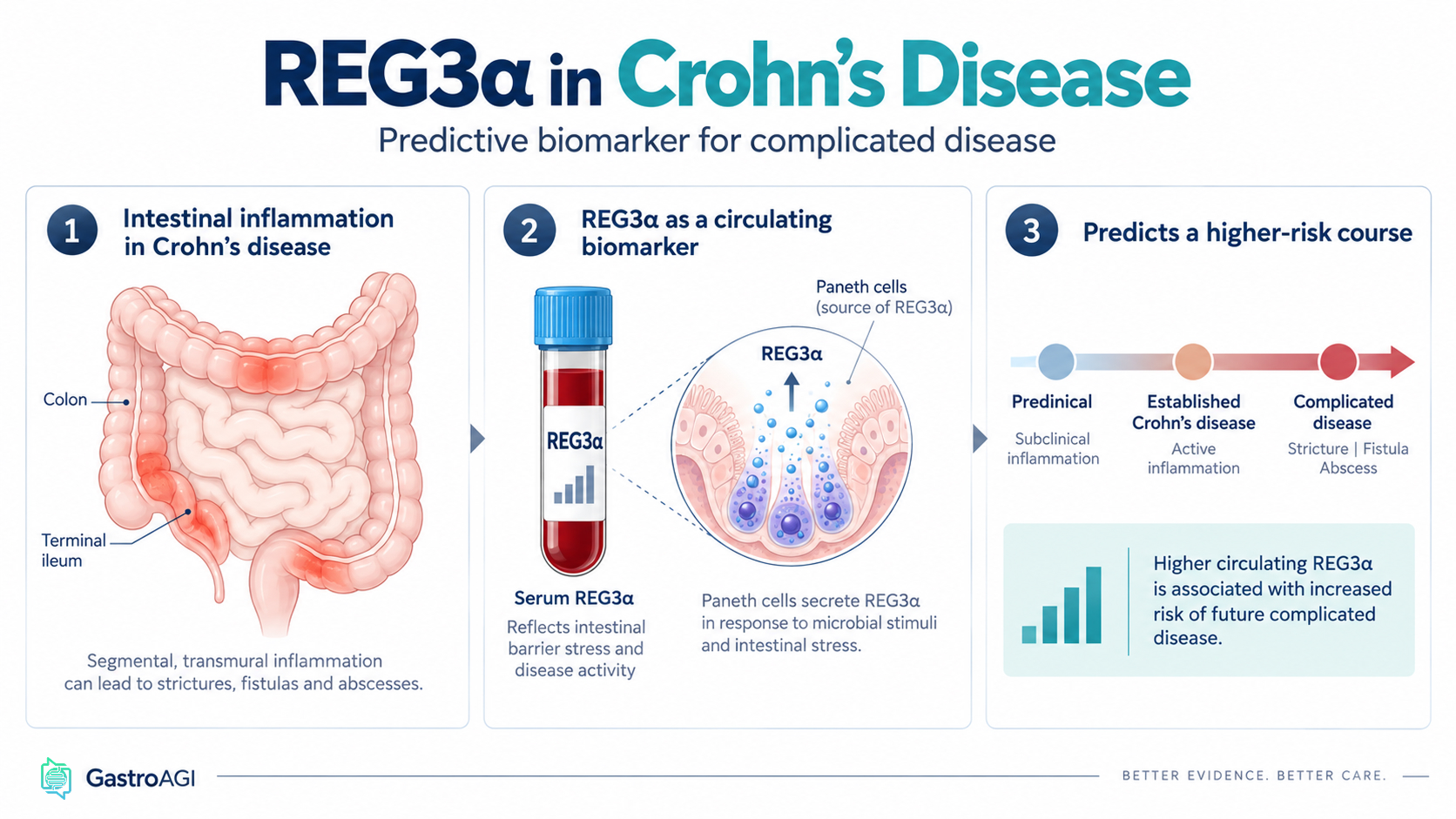
Can a patient with apparently mild Crohn’s disease already carry a biological signal of future complicated disease? And could that signal be detectable even before Crohn’s disease is clinically diagnosed?
These questions sit at the heart of modern inflammatory bowel disease care. Gastroenterologists increasingly aim to prevent bowel damage rather than simply react to flares, strictures, fistulas, hospitalizations, and surgery. Yet the tools available for prognostication remain imperfect. Clinical symptoms can underestimate inflammation. C-reactive protein may be normal in some patients. Endoscopic remission does not always guarantee a benign future course. For this reason, non-invasive biomarkers that identify patients at higher risk of progression remain a major unmet need.
A new article in Clinical Gastroenterology and Hepatology, titled “REG3α is a Predictive Biomarker of Complicated Disease from Preclinical through Established Crohn’s Disease,” explores whether serum regenerating islet-derived 3-alpha, or REG3α, may help fill part of this gap. The article was published online on September 2, 2026, after being received on January 27, revised on August 22, and accepted on August 24, 2026.
This is not a treatment trial and does not establish a new standard of care. It is a biomarker study evaluating associations between serum REG3α and Crohn’s disease progression across established and pre-diagnostic disease settings. Its value lies in the possibility that REG3α may reflect a biology of future disease behavior that is not fully captured by conventional markers of active inflammation.
A biomarker question rooted in Paneth cell biology
REG3α is described by the authors as a serum biomarker previously linked to 6-month mortality in graft-versus-host disease. It is produced by intestinal Paneth cells, which are implicated in Crohn’s disease pathophysiology. The study’s rationale therefore connects a measurable blood biomarker with a cell type already biologically relevant to Crohn’s disease.
The background provided by the journal also emphasizes defective autophagy and Paneth cell dysfunction as central features of Crohn’s disease pathophysiology. This matters because the study is not simply asking whether another inflammatory marker correlates with active disease. It is asking whether a Paneth cell–linked serum marker may identify a trajectory toward complicated disease, including in patients without overt active endoscopic inflammation.
For clinicians, the distinction is important. A biomarker that only mirrors current inflammation may be useful for monitoring activity. A biomarker that predicts future complications despite mild or inactive disease would have a different role: risk stratification. That is the clinical space in which REG3α is being evaluated.
What the investigators studied
The study objective was to assess associations between serum REG3α and progressive Crohn’s disease. Serum REG3α was measured in two adult Crohn’s disease cohorts, identified in the abstract as Mount Sinai and Leuven, and in a pre-diagnostic cohort, PREDICTS, with serial samples collected up to 10 years before Crohn’s disease diagnosis. Tissue REG3α expression was assessed using bulk RNA sequencing from paired ileal and colonic biopsies. Single-cell RNA sequencing data were used to explore associations between REG3α expression, Paneth cell phenotypes, and Crohn’s disease.
The clinical outcome of interest was Crohn’s disease progression. In the study, progression was defined as hospitalization, surgery, steroid course, or new advanced therapy. This composite endpoint is clinically relevant because it includes events that reflect worsening disease burden or escalation of care. However, it is also a composite, meaning that its components are not identical in clinical weight. Surgery, hospitalization, steroid use, and biologic or advanced therapy initiation may each reflect different clinical circumstances.
The study also examined the pre-diagnostic phase. In that setting, high serum REG3α was evaluated in relation to later Crohn’s disease development and, more specifically, complicated presentations such as B2/B3 disease behavior and surgical presentations.
The central finding: REG3α tracked with progression
In 394 patients, high serum REG3α was associated with Crohn’s disease progression independent of C-reactive protein and endoscopic activity. The reported hazard ratios were 1.9 in the Mount Sinai cohort, with a 95% confidence interval of 1.3–2.8, and 2.9 in the Leuven cohort, with a 95% confidence interval of 1.9–4.6. Both associations were statistically significant, with p values less than .001.
This result is clinically interesting because it suggests that REG3α may capture prognostic information beyond standard inflammatory assessment. The association persisted even among patients with mild or inactive Crohn’s disease, according to the article summary. The journal’s “What You Need to Know” section similarly states that higher serum REG3α was associated with progression even during endoscopic remission.
The wording here must be precise. REG3α was associated with progression. The study does not prove that REG3α causes progression, nor does it establish that modifying REG3α would alter disease course. It supports REG3α as a potential predictive or prognostic biomarker, not as a therapeutic target ready for clinical intervention.
Why independence from CRP and endoscopic activity matters
Many gastroenterologists already use CRP, fecal calprotectin, cross-sectional imaging, ileocolonoscopy, symptoms, and clinical risk factors to guide Crohn’s disease assessment. A new biomarker becomes clinically interesting only if it adds information beyond what clinicians already know.
The study reports that the association between high serum REG3α and disease progression was independent of C-reactive protein and endoscopic activity. This is one of the most important aspects of the paper. If confirmed, REG3α could potentially identify risk in patients who do not look high-risk based on conventional inflammatory measures.
That possibility is especially relevant for patients in apparent remission. Clinicians are often cautious about escalating therapy in patients who are asymptomatic or endoscopically inactive. A biomarker that helps identify patients still biologically predisposed to progression could influence future research into monitoring intensity or early intervention strategies.
However, this is not yet a recommendation to escalate therapy based on REG3α. The article supports potential risk stratification, not a validated treatment algorithm. Before REG3α can be used to make management decisions, clinicians would need evidence showing how to act on the result and whether acting improves outcomes.
The pre-diagnostic signal: biologic risk before clinical Crohn’s disease
One of the most distinctive elements of the study is the inclusion of a pre-diagnostic cohort with serial samples collected up to 10 years before Crohn’s disease diagnosis. In that cohort, high serum REG3α predicted the development of Crohn’s disease, particularly complicated B2/B3 and surgical presentations.
This finding fits into a broader conceptual shift in IBD research: Crohn’s disease may have a measurable preclinical phase before diagnosis. The source does not establish population screening or preventive treatment based on REG3α. But it does support the idea that some biological features linked to later complicated Crohn’s disease may be detectable years before conventional diagnosis.
For researchers, this is highly relevant. Pre-diagnostic biomarkers may help define high-risk populations, understand early disease biology, and design prevention-oriented studies. For clinicians, the immediate message is more restrained. REG3α is not yet a screening test for Crohn’s disease. Its pre-diagnostic association is hypothesis-generating and may guide future research rather than current population-level practice.
A mechanistic clue from tissue and single-cell data
The investigators did not limit the study to serum measurement. Tissue REG3α expression was assessed through bulk RNA sequencing from paired ileal and colonic biopsies. Single-cell RNA sequencing was used to explore links between REG3α expression, Paneth cell phenotypes, and Crohn’s disease.
The reported tissue and single-cell analyses suggested that Crohn’s disease was associated with loss of regenerative Paneth cell populations and enrichment in REG3α-expressing populations. The authors describe this as suggesting a mechanism through which changes in serum REG3α may associate with complicated Crohn’s disease.
This mechanistic component strengthens the biological plausibility of the biomarker signal. It links the serum observation to intestinal cellular phenotypes rather than leaving REG3α as an isolated blood marker. Still, mechanistic plausibility is not proof of causality. The tissue and single-cell findings help explain why REG3α may be associated with complicated disease, but they do not demonstrate that REG3α drives stricturing, penetrating disease, hospitalization, or surgery.
How this may influence clinical thinking
The most practical implication is risk stratification. The journal’s implication statement says that serum REG3α may improve risk stratification in Crohn’s disease by identifying patients at risk for future progression, including those with clinically mild or inactive disease. It also states that the findings support a potential role in guiding early intervention strategies and personalized disease monitoring.
For a practicing gastroenterologist, this could eventually matter in several scenarios. A patient with mild symptoms but elevated REG3α might be considered for closer follow-up in a future validated pathway. A patient in endoscopic remission but with high REG3α might be studied as a subgroup needing different monitoring intervals. A pre-diagnostic biomarker profile might one day help identify individuals at risk of complicated disease before irreversible bowel damage occurs.
These are potential future applications, not current mandates. The source does not provide a clinical cutoff, testing platform standardization, cost-effectiveness analysis, management algorithm, or prospective interventional evidence showing that REG3α-guided care improves outcomes.
What clinicians should not conclude
Clinicians should not conclude that REG3α is ready to replace existing disease activity assessment. The study reports association independent of CRP and endoscopic activity, but that does not mean REG3α supersedes colonoscopy, imaging, fecal calprotectin, clinical assessment, or established risk factors.
Clinicians should also not conclude that a high REG3α result mandates biologic therapy, steroid treatment, hospitalization prevention strategy, or surgery referral. The endpoint included new advanced therapy and steroid course, but the biomarker was not tested as a treatment-decision tool.
Most importantly, association must not be confused with causation. High serum REG3α was linked with progression and complicated disease patterns. The study does not prove that REG3α causes these outcomes, nor does it show that reducing REG3α would reduce risk. The correct interpretation is prognostic: REG3α may help identify patients more likely to follow a complicated course.
Strengths that make the signal worth attention
Several features make the article clinically noteworthy. It included more than one established Crohn’s disease cohort, incorporated a pre-diagnostic cohort, and combined serum biomarker analysis with tissue and single-cell transcriptomic exploration. The association with progression was reported in two cohorts and persisted independent of CRP and endoscopic activity.
The inclusion of mild or inactive disease is also important. Biomarkers that only identify obvious active inflammation may add limited value. A marker that identifies risk outside overt activity could address a real gap in Crohn’s disease prognostication.
The pre-diagnostic component is another strength from a research perspective. It suggests that REG3α may not simply reflect late complications but may be detectable before clinical diagnosis in some patients who later develop complicated Crohn’s disease.
Limitations and uncertainties
The available source does not provide all methodological details needed for full critical appraisal. It does not fully describe cohort inclusion criteria, assay thresholds, missing data handling, medication exposure, disease duration, phenotype distribution, or calibration metrics. It also does not provide a clinically validated cutoff for REG3α interpretation.
The outcome definition combines hospitalization, surgery, steroid course, and new advanced therapy. While all are clinically relevant, they can be influenced by practice patterns, access to care, physician preference, disease severity, and healthcare system factors. Advanced therapy initiation, in particular, may reflect clinician decision-making as well as disease biology.
The study’s conclusion is appropriately cautious: serum REG3α holds potential as a non-invasive prognostic biomarker. That word—potential—is important. Before implementation, the field needs prospective validation, assay standardization, threshold definition, assessment across diverse populations, comparison with existing biomarkers, and interventional trials testing whether REG3α-guided management improves patient outcomes.
Clinical Takeaway
REG3α is an intriguing Paneth cell–linked serum biomarker associated with Crohn’s disease progression from the preclinical phase through established disease. In the reported cohorts, high serum REG3α was associated with progression independent of CRP and endoscopic activity, and the signal persisted even in mild or inactive disease. In a pre-diagnostic cohort, high REG3α predicted future Crohn’s disease, particularly complicated B2/B3 and surgical presentations.
For clinicians, the message is promising but not practice-changing. REG3α may eventually help refine Crohn’s disease risk stratification, especially where current inflammatory markers underestimate future risk. At present, however, it should be viewed as a research-supported prognostic biomarker candidate—not a standalone clinical decision tool. The next step is not routine adoption, but rigorous validation and testing of whether REG3α-guided monitoring or treatment strategies can improve outcomes.

Five key clinical takeaways
REG3α is a Paneth cell–linked serum biomarker evaluated for its association with Crohn’s disease progression.
High serum REG3α was associated with disease progression in 394 patients, independent of CRP and endoscopic activity.
The association persisted in mild or inactive disease, suggesting potential value beyond conventional activity assessment.
In pre-diagnostic samples, high REG3α predicted later Crohn’s disease, particularly complicated B2/B3 and surgical presentations, up to 10 years before diagnosis.
This is not yet practice-changing guidance: REG3α remains a promising prognostic biomarker candidate requiring validation, standardization, and evidence that biomarker-guided care improves outcomes.

We are pioneers in clinical intelligence, dedicated to helping gastroenterologists harness the power of artificial intelligence to drive precision, efficiency, and patient growth.