
Maddrey's Discriminant Function: How to Calculate It Correctly
How to calculate Maddrey's discriminant function correctly - the formula, which control PT to use, and the errors that skew the score.


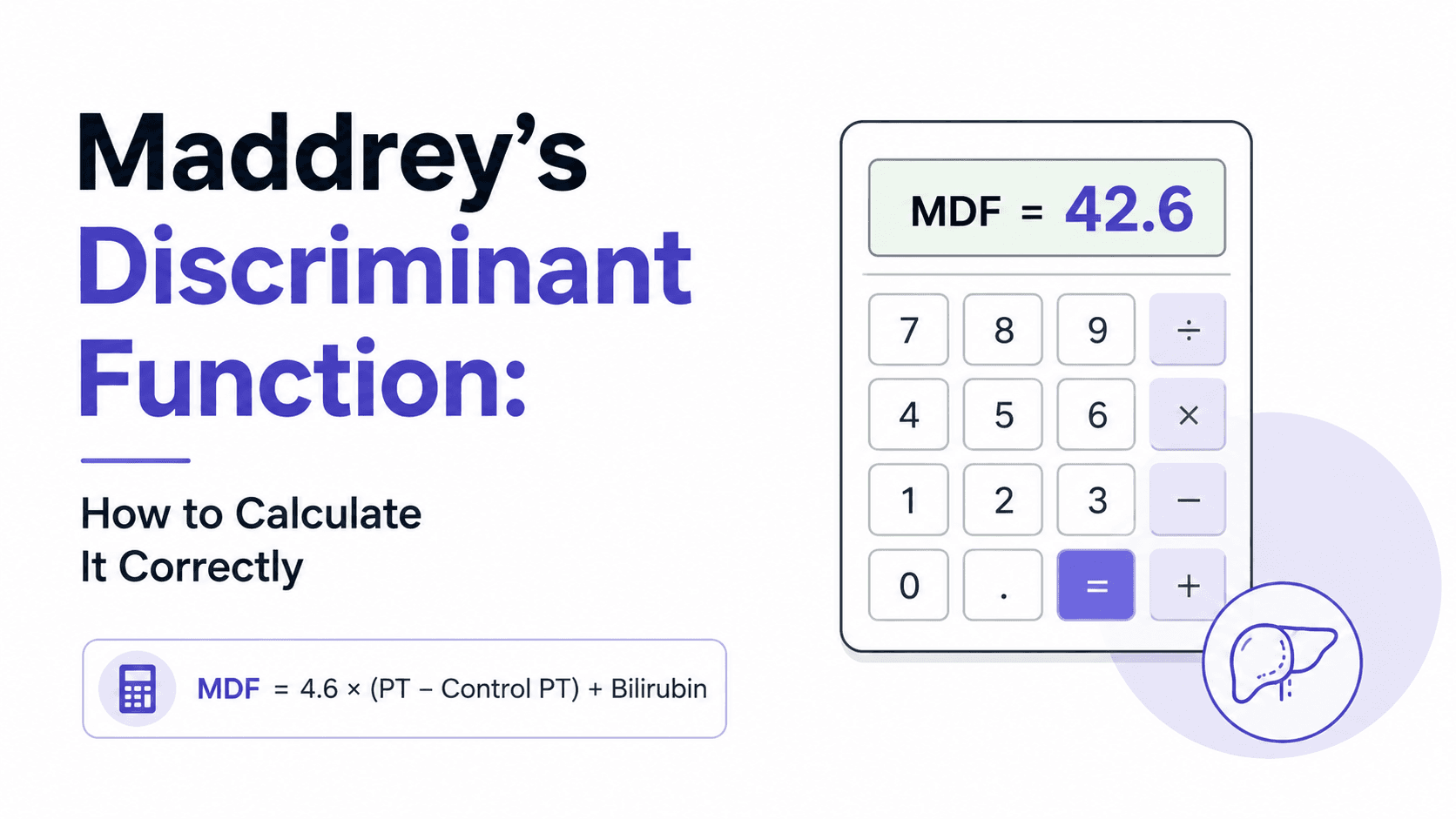
A resident calculates a DF of 28 on a patient with suspected alcoholic hepatitis, rounds the prothrombin time control down for convenience, and misses the steroid-eligible cutoff by four points that shouldn't have been there. The formula has two inputs and one constant - and it's still one of the most commonly miscalculated bedside scores in hepatology. This post walks through exactly how to calculate it, which control PT to use, and where the errors creep in.
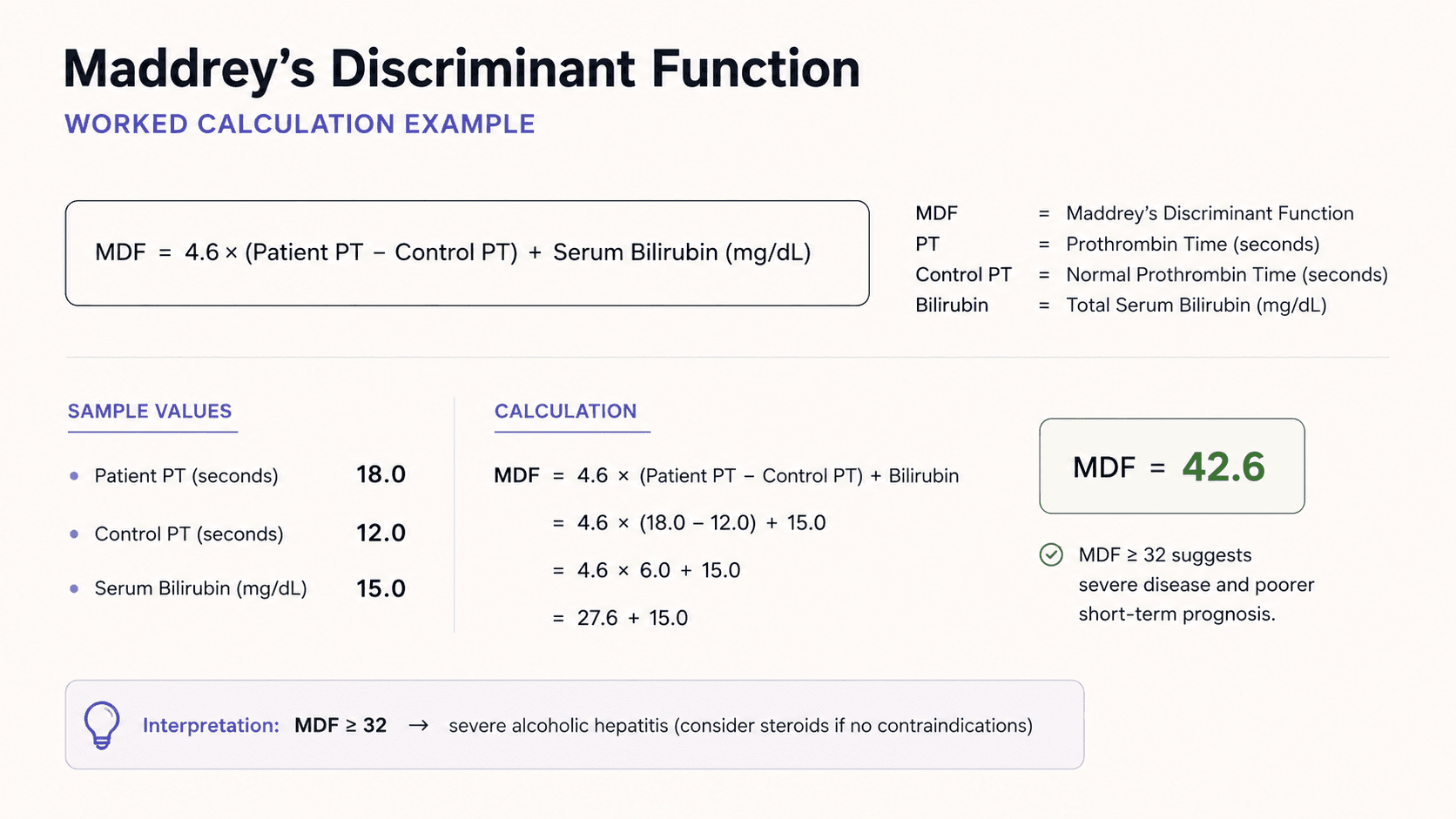
Maddrey's discriminant function (MDF) is calculated as 4.6 × (patient's prothrombin time in seconds − control prothrombin time in seconds) + total bilirubin in mg/dL. Every input looks straightforward until you're the one entering it: which control PT your lab uses isn't standardized, bilirubin units get mixed up between mg/dL and µmol/L, and a lab-to-lab difference in control PT of even 1–2 seconds can shift the calculated DF enough to change whether a patient crosses the 32-point threshold. Getting the Maddrey discriminant function formula right isn't a triviality before the clinical decision - it's the clinical decision, since the entire score exists to answer one binary question at one specific cutoff.
Check out: MELD-Na score interpretation
The Formula, Step by Step
Start with the two lab values you need: total bilirubin (mg/dL) and prothrombin time (seconds), plus your lab's control PT - the reference PT value your coagulation lab uses for a healthy control, not the patient's own baseline. Subtract the control PT from the patient's measured PT, multiply that difference by 4.6, then add the total bilirubin. So a patient with a PT of 22 seconds, a lab control PT of 12 seconds, and a bilirubin of 9.8 mg/dL calculates as 4.6 × (22 − 12) + 9.8 = 55.8. That patient clears the DF >32 threshold associated with roughly 35–45% one-month mortality without treatment, making them a candidate for corticosteroid consideration pending the usual contraindication screen. If bilirubin is reported in µmol/L rather than mg/dL, divide by 17 first - skipping that conversion is one of the most common calculation errors and produces a wildly inflated score.
Case in point
A 47-year-old man with heavy alcohol use is admitted with jaundice. His bilirubin returns at 9.8 mg/dL and his PT at 21 seconds. The admitting team uses their hospital lab's stated control PT of 12.5 seconds and calculates a DF of 44.9 - clearly above 32. A senior resident recalculates using 13.5 seconds, the control value used in a different published study she remembers, and gets a DF of 42.7. Both numbers land the patient in the same clinical category, but the discrepancy prompts the team to actually check which control PT their own institution's coagulation lab reports.
That check matters more than it seems. A retrospective review of 882 patients found that the specific control PT used in the calculation affected whether patients were flagged for steroid consideration, even though it didn't change 30-day survival outcomes - meaning the choice of control PT can move a patient across the treatment-eligibility line without reflecting a real difference in their disease severity. Confirming your institution's control PT value once, rather than assuming a number from memory or a paper, removes that variability entirely.
Where the Score Gets Miscalculated in Practice
The most frequent real-world error isn't the arithmetic - it's using the wrong control PT, either an outdated value, a different lab's published constant, or, occasionally, the patient's own PT from a prior admission mistaken for a control value. Always use your own coagulation lab's stated control PT, printed on most PT/INR reports or available from lab services directly, not a number memorized from a textbook or a different hospital's protocol. The second common error is unit mismatch on bilirubin, particularly in settings that report in SI units by default. The third, more subtle error is timing: calculating the DF from labs drawn before adequate resuscitation or before an evolving infection is treated can produce a transiently elevated score that doesn't reflect the patient's true baseline severity a day or two later. None of these errors are in the formula itself - the formula is fixed and simple. They're all in the inputs, which is exactly why the score is so easy to get wrong despite being so easy to compute.
A frequently overlooked point
Clinicians sometimes recalculate the DF daily expecting it to track clinical trajectory the way MELD does, and get confused when a patient looks worse but their DF barely moves. The DF wasn't designed as a continuous severity tracker - it's a single-timepoint threshold test, calculated once at presentation to answer one question. Trending it daily like a MELD score isn't wrong exactly, but it's asking a static eligibility gate to do the job of a dynamic prognostic score, and the number will disappoint you if that's what you expect from it.
Bottom line for clinical practice
Formula: 4.6 × (patient PT − control PT in seconds) + total bilirubin in mg/dL.
Confirm your institution's actual control PT value before calculating - don't use a remembered or textbook figure.
Convert bilirubin from µmol/L to mg/dL (divide by 17) before plugging it into the formula if your lab reports in SI units.
A DF above 32 is the threshold associated with significant short-term mortality and the trigger for steroid-candidacy evaluation.
Calculate once at presentation on stable, resuscitated labs - the DF is a single-timepoint threshold, not a daily trending score.
Once you have the number, the harder question is what to do with it - our post on Maddrey's discriminant function and steroid candidacy covers exactly that decision, including the contraindications that make a DF above 32 reversible. And if a patient's picture involves both alcoholic hepatitis and cirrhosis, MELD-Na score interpretation breaks down which score answers which question. Run the calculation through GastroAGI directly and skip the control-PT guesswork entirely.


We are pioneers in clinical intelligence, dedicated to helping gastroenterologists harness the power of artificial intelligence to drive precision, efficiency, and patient growth.