
Rome V Criteria for IBS: What the New Frequency Threshold Actually Changes
Rome V changes the IBS frequency threshold and reincludes abdominal discomfort. Here's exactly what changed, why, and how it affects diagnosis in practice.


A 29-year-old presents with cramping abdominal discomfort - not quite pain - three days a month, tied loosely to altered stool form. Under Rome IV, she doesn't meet criteria for IBS. Under Rome V, published May 2026, she does. Same patient, same symptoms, different diagnosis. This post walks through exactly what changed and why it matters for how you code, treat, and counsel patients starting now.
Rome IV tightened IBS diagnosis considerably from Rome III, requiring abdominal pain - not discomfort - at least one day per week over the preceding three months. That threshold was defensible on paper but never sat well in clinic: patients who plainly had IBS by every other measure kept landing in "unspecified functional bowel disorder" because their symptom diary didn't clear the bar. Rome V is a direct response to that mismatch, part of the broader overhaul of the disorders of gut-brain interaction framework published in May 2026. The core diagnostic criteria for Rome V IBS now better reflect how patients actually present, and getting the threshold change right matters for coding accuracy, trial eligibility, and - increasingly - for not dismissing patients whose symptoms are real but don't fit last decade's cutoff.
What Changed From Rome IV to Rome V
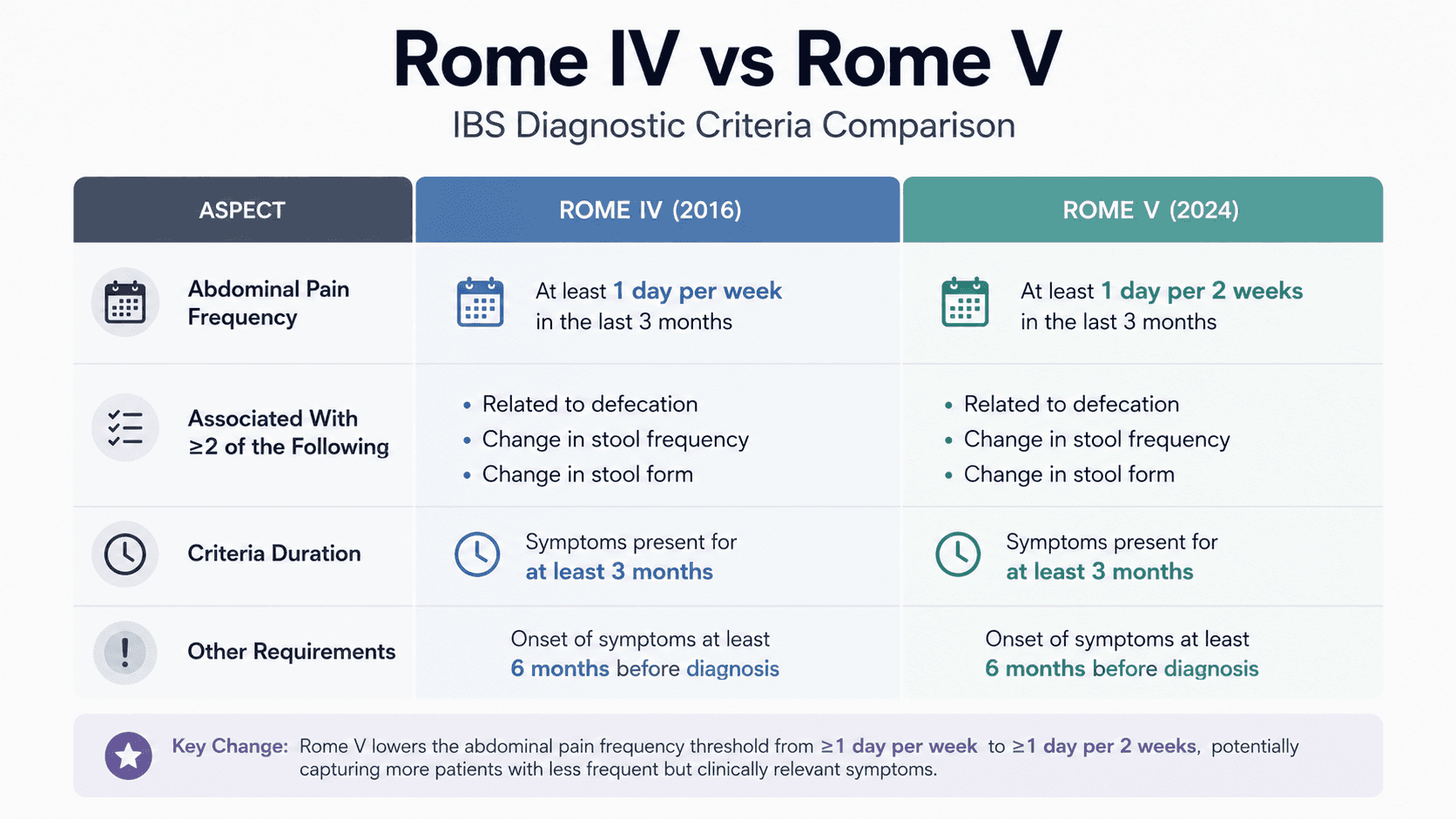
Two specific revisions define the update. First, abdominal discomfort is back as a qualifying symptom alongside pain - Rome IV had dropped discomfort entirely, requiring pain specifically. That exclusion turned out to systematically underrepresent patients in populations where discomfort, rather than frank pain, is the dominant descriptor of their symptoms. Second, and more consequential in practice: the frequency requirement dropped from at least one day per week to at least three days per month over the same three-month window. This wasn't an arbitrary loosening. A global epidemiology study spanning more than 50,000 individuals found the stricter Rome IV threshold cut measured IBS prevalence roughly in half - from around 10% down to 4% - not because fewer people had the condition, but because the weekly-pain requirement screened out patients with clinically significant, intermittent symptoms. The rest of the IBS framework - the requirement that symptoms relate to defecation, a change in stool frequency, or a change in stool form, with at least two of three present - carries over from Rome IV largely intact. This is a recalibration of sensitivity, not a rewrite of the underlying construct.
Case in point
A 34-year-old woman has intermittent lower abdominal cramping that partially resolves after a bowel movement, occurring on roughly three days most months, alongside loose stools on those same days. She has no alarm features - no weight loss, no rectal bleeding, no nocturnal symptoms, no family history of IBD or colorectal cancer, and basic labs are unremarkable. Under Rome IV, her symptom frequency falls short of the once-weekly pain threshold, and she's technically classified as an unspecified functional bowel disorder despite a textbook clinical picture.
Reassessed under Rome V, she meets criteria for IBS with predominant diarrhea outright. The diagnosis doesn't change her workup - she still didn't need a colonoscopy based on her age and lack of alarm features either way - but it changes what you tell her, how you code the encounter, and whether she's eligible for IBS-specific trials or FDA-approved IBS therapies that require a formal diagnosis to prescribe.
Applying the New Threshold in Practice
The practical shift is in how you take the history. Where a Rome IV-era clinician might ask "how often do you get pain, and is it at least weekly," the Rome V-appropriate question is broader: "how often do you notice pain or discomfort, and does three days a month sound right." Patients who previously answered "off and on, maybe a few times a month" and got waved off as non-diagnostic now clear the bar. This matters most for two groups: patients with genuinely intermittent symptoms who were previously under-coded, and patients whose native symptom vocabulary leans toward "discomfort" or "unease" rather than "pain" - a pattern noted more often in some populations than others, which was part of the rationale for reincluding discomfort in the first place. The subtype classification itself - IBS-C, IBS-D, IBS-M, IBS-U, based on predominant stool pattern - is unchanged. What's changed is simply how many patients clear the gate to be classified at all. As with Rome IV, the diagnosis remains clinical: alarm features still warrant investigation regardless of how neatly a patient fits the symptom criteria.
A frequently overlooked point
The instinct with any loosened diagnostic threshold is to worry about overdiagnosis, but that's not really the risk here - the risk under Rome IV was underdiagnosis, and Rome V is a correction toward accuracy, not a lowering of the bar for convenience. The patients newly captured by the three-day-a-month threshold aren't marginal cases invented by a committee; they're the same patients who were always symptomatic and simply weren't being counted. If anything, clinicians who kept a mental Rome III-era threshold running in the background - treating patients as IBS based on clinical gestalt even when Rome IV technically excluded them - will find Rome V finally matches what they were already doing.
Bottom line for clinical practice
Recheck your mental frequency threshold: Rome V requires symptoms at least three days per month, not one day per week, over the preceding three months.
Abdominal discomfort now qualifies alongside pain - don't discount a patient because they describe unease rather than frank pain.
The two-of-three defecation-related criteria (relation to bowel movement, change in stool frequency, change in stool form) are unchanged from Rome IV.
IBS subtyping (IBS-C, IBS-D, IBS-M, IBS-U) is unaffected - only the qualifying threshold to reach a diagnosis has moved.
Alarm features still override symptom criteria entirely; Rome V doesn't change your threshold for further workup.
Running a borderline case through the new thresholds by hand is exactly the kind of check GastroAGI is built for. And once a patient is confirmed under the new criteria, treatment selection is its own decision tree - our post on SNRIs and other neuromodulators in IBS covers that next step. Walk a case through GastroAGI directly and it'll flag whether a patient clears Rome V criteria, no manual recalculation required. Try GastroAGI.


We are pioneers in clinical intelligence, dedicated to helping gastroenterologists harness the power of artificial intelligence to drive precision, efficiency, and patient growth.